
Return to the search form Return to your search results
Exploring Major Determinants of Health in Spain
Fast Facts
Sessions Offered:
Summer
Location:
Madrid & Barcelona, Spain
Credit:
Resident
Eligibility:
3.0 GPA, good academic and disciplinary standing, health-related major, 1 semester of college-level study
Application Deadline:
January 31
Program Cost:
Refer to the Application tab
Program Description

Spain is often cited as the healthiest country in the world by the Bloomberg Global Health Index. This course will take a socioecological view and explore determinants of health outcomes in Spain. Students will be exposed to a variety of individual, organizational, community, and structural systems in two major Spanish cities - Madrid and Barcelona. Students will be charged with: 1) identifying major determinants of health in Spain; 2) comparing them to similar determinants within the United States; 3) considering how these determinants might differentially contribute to health disparities in Spain vs. the U.S.; and 4) brainstorming ways in which health promoting determinants in Spain might be applied within the United States to improve public health.
Academic Program

Taught by UI Department of Health and Human Physiology professor Dr. Lucas Carr, this three-week course carries three (3) semester hours of resident credit and is taught in English (no foreign language proficiency is required).
The course is approved as a major elective for the Health Studies, Health Promotion, Exercise Science, and Human Physiology majors within the Department of Health and Human Physiology.
Important: Please note that this program is highly competitive and there is a possibility that it will fill up before the designated deadline. We recommend that you apply for the program as soon as possible. Students are not advised to wait until closer to the deadline to apply as they will risk being waitlisted. We cannot guarantee placement in the program if students are waitlisted.
Once the course has filled, UI Study Abroad will maintain a waitlist and notify any students who are waitlisted. Further information will be sent out at that time to waitlisted students regarding next steps.
Cultural Activities

The program will include visits to sites of historic and cultural significance in Madrid and Barcelona, as well as health-related excursions and activities in both cities. Possible activities include the following:
- Hiking in El Escorial and visit to monastery
- Paella cooking class
- Madrid and Barcelona city tours
- Market tours
- Visits to parks and outdoor gyms in Madrid and Barcelona
Program Dates
Dates for the summer 2026 session are May 24 - June 11. The group will depart from the U.S. on May 24 and arrive in Spain on May 25.
See the Logistics tab for more information on travel arrangements.
For More Information
Prof. Lucas Carr, Faculty Director
UI Department of Health and Human Physiology
Email: lucas-carr@uiowa.edu
Cory Petersen, Senior Study Abroad Advisor & Program Coordinator
International Programs
1111 University Capitol Centre
The University of Iowa
Iowa City, IA 52242
Phone: 319-335-0353
Email: cory-petersen@uiowa.edu
Madrid

The Spanish capital of Madrid is a city of great cultural and political prominence. It is widely considered to be one of the most energetic capital cities in Europe and is home to some of the finest art museums in the world. Its centralized location makes it an ideal starting point for any trip to other Spanish cities or to neighboring countries. The city is a melting pot for all regions of Spain, yet it has maintained its own well-defined character. Madrid is known for its modern skyline but has successfully preserved the look and feel of many of its historic neighborhoods and streets. This cohesive mixture of old and new is evident in every facet of madrileño culture, making this capital city a true Spanish treasure to explore.
Barcelona

Barcelona is the capital of Catalonia, a region in northeastern Spain with its own distinctive history, culture, and language. Situated between the mountains and the Mediterranean Sea, Barcelona has a population of 1.6 million. Walking through the city, one can observe 2,000 years of architectural history including the Roman and medieval center’s impressive network of narrow streets, the 19th-century Eixample district with its original examples of Modernista architecture, and the ultra-modern buildings that continue to redesign the skyline.
Spain
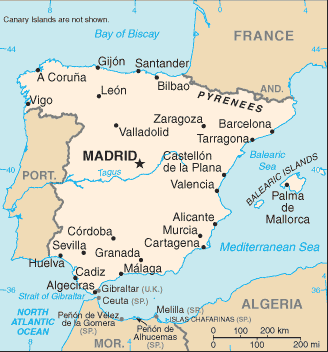
Situated on Europe’s Iberian Peninsula, Spain is a strikingly beautiful and diverse country. The country has the third largest number of UNESCO World Heritage sites. Spain’s distinct regions means there is something for everyone, from lush forests to towering mountains and stunning beaches to vibrant cities, many of which are easily accessible through the country's extensive network of high-speed trains. Widely known for excellent food and art, friendly locals, relaxed lifestyle, Flamenco culture, and lots of sunshine, Spain has been one of the cultural centers of Europe for thousands of years and remains one of the most popular destinations in the world for study and travel.
US Department of State Country Information
The US Department of State provides safety and security information for every country of the world to help you assess for yourself the risks of travel. Each country information page contains a Travel Advisory, Alerts, and other important details specific to that country that could affect you.
Pay close attention to the entry and exit requirements, local laws and customs, health conditions, and other details to help decide whether traveling to any given country is right for you. Non-US citizen travelers may also wish to seek guidance from the embassy of their country of citizenship. The UI International Travel Policy for Students addresses restrictions on student travel to high-risk locations and engagement in high-risk activities abroad.
Living Arrangements
Students will be housed in multiple occupancy rooms in hostels or hotels in Madrid and Barcelona. Students will only be housed with other participants in the program. Rooms will include a private bathroom. Accommodations will include breakfast daily.
Passport
U.S. Citizens
U.S. citizens who do not have a passport should apply for one as soon as possible. More information about how to apply for a passport is available on the U.S. Department of State’s website.
Students with a valid passport should check the expiration date. Passports must be valid for at least 6 months after the anticipated return to the US from studying abroad. US citizens who need to renew their passport can find more information on the US Department of State’s website.
Expedited processing service is available at an additional cost. UI Study Abroad encourages students to ask the passport agency at the time of application whether expedited service is recommended.
Non-U.S. Citizens
Students who are not U.S. citizens should contact UI Study Abroad (study-abroad@uiowa.edu) for information on how to ensure that their passport is valid for the duration of their time abroad.
Travel Arrangements
UI Study Abroad will designate a suggested group flight by early spring. Participants will make their own travel arrangements to Spain with guidance from UI Study Abroad and are advised to take part in this suggested itinerary.
The cost of travel is not included in the course fee.
Arrival arrangements at the airport in Spain and transportation to the program site will be based on the suggested flight. Alternative arrangements for transportation from the airport to the program site for students who do not participate in the suggested flight can be made with guidance from UI Study Abroad.
Do not purchase plane tickets until you have received instructions from UI Study Abroad. Plan to purchase your plane tickets by early April.
Local Transportation

Participants will be provided with public transit passes for use in Madrid and Barcelona. Private transportation for certain program activities and excursions will be provided.
Eligibility
This program is open to UI students who fulfill the following requirements:
- Good academic and disciplinary standing: Students must be in good academic and disciplinary standing at the University of Iowa. Academic and disciplinary history will also be considered when determining whether a student is prepared to represent the University of Iowa as part of this program. Students who, even after being accepted into a program, are put on either academic and/or disciplinary probation for any period of time overlapping with the study abroad program dates are ineligible to study abroad. In these cases, students must forfeit their acceptance, will not be allowed to study abroad, and are wholly responsible for any and all financial expenses incurred.
- Minimum 3.0 cumulative GPA: Students must have at least a 3.0 cumulative GPA. Applications from students who have a GPA below 3.0 may be considered for the program but will be interviewed by the faculty director in order to make a final acceptance decision.
- Major program of study: Preference given to majors in Health, Sport, and Human Physiology and other health-related majors.
- Completion of at least one semester of college-level study: First-year student applicants may be required to provide an academic reference in addition to other application materials. Preference given to juniors and seniors.
- Physical activity requirements: Students should be prepared to engage in physical activity daily. This program involves walking extensively in an urban environment and may include an (optional) guided bike tour. On some excursions outside urban areas, hikes of 2-3 hours will take place on flat or slightly inclined (T1) trails. To discuss reasonable accommodations for students with disabilities, please contact safety-abroad@uiowa.edu.
- Demonstrated preparedness and maturity: Students must demonstrate preparedness to take on the heightened responsibilities associated with international study and travel. Students must demonstrate a commitment to behave responsibly abroad while respecting cultural differences. Students are expected to obey both local laws and program directives conveyed to participants before and during the program. The University of Iowa Code of Student Life applies to all program participants while abroad.
- Clear interest and commitment: This program is open to students of all academic backgrounds. Students must demonstrate a clear academic or personal interest in the program’s subject matter and a commitment to engage responsibly in coursework abroad.
- Approval by faculty director and UI Study Abroad: Applications will be reviewed by the program’s faculty director, and students will be accepted based on their eligibility and application materials.
- Attendance at mandatory orientation programming: Students must attend all in-person and online pre-departure orientation programming.
This course is taught in English. There is no Spanish language requirement for participation in this course.
Costs
Students will be responsible for paying many of their program costs through their University of Iowa U-Bill, while other costs will be out-of-pocket costs paid by the student directly to vendors before and after going abroad. Refer to the cost sheets below for details on the costs associated with this program.
The cost sheets outline the total estimated costs associated with participating in this program and can be used for financial aid purposes. They include fees charged on students’ U-Bill as well as out-of-pocket expenses. Actual out-of-pocket expenses will vary from individual to individual. Quoted estimates are conservatively high, yet realistic.
Costs for future sessions are usually similar to the current session, however students can expect a modest increase in overall costs each session. Final cost sheets for future sessions are typically available early in the semester before the session begins.
Cost Sheet
See below for a cost sheet for the summer 2026 session.
 Cost Sheet- Exploring Major Determinants of Health in Spain- Summer 2026
Calculating Fees
The cost sheets are based on the fees described below:
- University of Iowa Study Abroad Administrative Fees
- University of Iowa’s CISI health insurance
- Program course fees, housing, flight, and other costs of attendance
Costs charged to the U-Bill
- Application fee (charged at the time of application, before financial aid/scholarships disburse)
- Course Fees (Includes tuition, housing, program-related transportation, and excursions (charged shortly before departure)
- Study Abroad Fees (charged shortly before departure)
- CISI Health Insurance (charged shortly before departure)
Out-of-pocket costs (not charged to U-Bill)
- Round trip airfare from Cedar Rapids (paid by student directly to travel agent or airline- approx. 6-8 weeks prior to departure, before financial aid/scholarships are disbursed)
- Most meals (paid by student as needed while abroad)
- Passport (paid by student prior to departure, before financial aid/scholarships are disbursed)
- Medical exam/immunizations (paid by student as needed prior to departure, before financial aid/scholarships disburse)
- Personal expenses (paid by student at their discretion while abroad)
Scholarships & Financial Aid
You can find information about options for funding your study abroad experience, including financial aid, scholarships, grants, etc., on UI Study Abroad’s Finances page.
Students are encouraged to apply for the Need-based, Merit, and Leona Zaharis scholarships awarded by UI Study Abroad, along with any other scholarship they are eligible for. More information is available on the Scholarships for Study Abroad page.
Students who receive a Federal Pell Grant are eligible to apply for the Benjamin A Gilman International Scholarship, an external scholarship awarded by the Department of State. Learn more on the Gilman scholarship page .
How to Apply
Students Attending the University of Iowa
- Meet with your academic advisor(s) to discuss how this program might fit your graduation plans, and to ensure that it meets your academic and personal goals.
- If you and your academic advisor agree that this program is a good match for you, complete the UI Study Abroad application. Please note that the non-refundable $50 application fee will be charged to your U-Bill as part of this online application.
- Submit the online application before the application deadline.
- The faculty director and your study abroad advisor will review your application materials. Admission decisions will be based on meeting the eligibility requirements and on the submission date of the application. Preference is given to early applicants. You will be contacted with your acceptance status shortly after the application deadline.
Post-Acceptance
Confirmation
If you are accepted to the program, you will be asked to commit to participating in your program by submitting the University of Iowa's Confirmation of Participation form by early February.
After you have formally confirmed your plans to participate, you will work both with UI Study Abroad and our partner institution abroad. Follow instructions from both. Later in the semester, your UI study abroad advisor will contact you regarding purchasing plane tickets, orientation, registration, and other required UI procedures and documentation.
Application Deadline
The application deadline for the Summer 2026 will be January 31.
Health & Safety Planning
Students should carefully review the following materials starting at least two months prior to departure:Iowa Regents CISI Health Insurance Information
Immigration/Visa
All program participants are required to complete immigration requirements to enter and study in your host country. UI Study Abroad and your program provider/host institution abroad will provide you with immigration instructions prior to departure.
Note that permission to enter and study in your host country is provided exclusively by the host country’s government based on that country's immigration requirements. Your host country’s immigration requirements may include considerations related to specific national origin, national heritage, criminal background status, and similar issues that can make it impossible to receive permission to enter the country in some cases. Contact your UI study abroad advisor for more information.
It is essential that you thoroughly review all of your immigration materials before you leave for your host country to ensure that they are absolutely complete and accurate. It is entirely your responsibility to ensure that all of your immigration materials are in order and fully accurate before you leave for your host country. If any of your immigration materials contain inaccurate information of any kind, contact your UI study abroad advisor immediately to discuss your options.
Do not take steps to complete your host country’s immigration requirements until you receive more information from UI Study Abroad.
Review the UI Study Abroad Travel Documentation website for further guidance on the immigration/visa process.
Orientation
In order to prepare for your time abroad, you are required by the University of Iowa to complete two orientations. These may be in addition to orientations provided by your on-site provider. See below for more information.
Online Education Abroad Pre-Departure Orientation
You are required to complete the International Programs ICON course "Education Abroad Pre-Departure Orientation" prior to departure. This orientation is mandatory for all students going abroad under the auspices of the University of Iowa. It covers many practical matters about living overseas, such as health and safety, communication, money, goals, and much more. You will be enrolled in this course by International Programs and an email will be sent to you once enrolled. If you have any questions, you can email safety-abroad@uiowa.edu.
Program-Specific Orientation
This orientation will be facilitated by your UI study abroad advisor and will cover content specific to your program and host country. It could be conducted in a group setting or one-on-one depending on your type of planned activity abroad. Your study abroad advisor will send you more information about this mandatory in-person session.